




The Ultimate Guide to Foot Rests: Improve Leg Posture, Reduce Fatigue & Choose the Right Model
Comprehensive, practical, and evidence-informed—this pillar guide explains what foot rests do, why they matter for posture and circulation, how to choose one, how to set it up correctly, and how to avoid common mistakes. Includes HowTo & FAQ structured data to improve discoverability.
Why This Guide (TL;DR)
This guide is designed to do three things differently from typical product or listicle pages:
- Depth & mechanics: explain the biomechanical and circulatory mechanisms by which foot rests affect posture and leg health—so readers understand the “why”, not just the “what”.
- Actionable setup: give step-by-step instructions, a decision matrix for buying, a setup checklist, and troubleshooting tips so readers can implement solutions immediately.
- Authority & trust: include evidence-informed reasoning and scenario-based recommendations for different user groups (short people, pregnant individuals, sit-stand workers, gamers, etc.).
Short takeaway: A properly chosen and positioned foot rest improves comfort and reduces risk factors related to prolonged sitting—especially for people whose feet don't firmly reach the floor or who sit for long periods without movement. However, it is a complement to—not a replacement for—regular movement and overall ergonomic setup.
What Is a Foot Rest? Types & Design Features
Definition: A foot rest (also called footstool, foot support, or under-desk footrest) is a raised platform placed under a seated person's feet to support them, improve lower-limb posture, and reduce pressure on the legs. Foot rests range from simple foam pads to adjustable mechanical platforms with tilt, rocking, or textured surfaces.
Common Types
- Fixed foam or molded foot rest: Low-cost, non-adjustable platforms—good for brief support or for users who require minimal height change.
- Adjustable-height foot rest: Allows vertical changes to accommodate different chair heights and user statures; preferred in shared workspaces.
- Tilt/angle adjustable foot rest: Provides a sloped surface that can help maintain a neutral ankle position and reduce calf strain.
- Active/rocking foot rest: Enables subtle movement (rock or roll) which encourages micro-muscle activation and blood flow.
- Ergonomic contoured foot rest: Designed with a curved or textured surface to aid placement and reduce slipping—some are designed to reduce plantar pressure.
- Inflatable or portable foot rest: Travel-friendly solutions for airplanes or temporary workstations.
Key Design Features to Watch
- Height range: The vertical adjustment span—critical for matching different chair/desk setups.
- Tilt angle: A small, adjustable tilt (5–15°) can promote a neutral ankle position.
- Platform area: Enough surface area to place both feet comfortably; some user prefer for heels to rest entirely on the platform.
- Friction/texture: Prevents slipping; textured top also encourages subtle foot movement.
- Stability: Non-slip base and sturdy construction to support repeated use.
- Portability: Lightweight models or foldable designs for shared desks or travel.
- Materials: Memory foam vs hard plastic vs wood impacts comfort and durability.
The Biomechanics: How Foot Support Affects Your Legs & Spine
Understanding the mechanism helps design solutions that actually work. Below we unpack how foot support interacts with joints, muscles, and circulation.
1. Joint angles and skeletal alignment
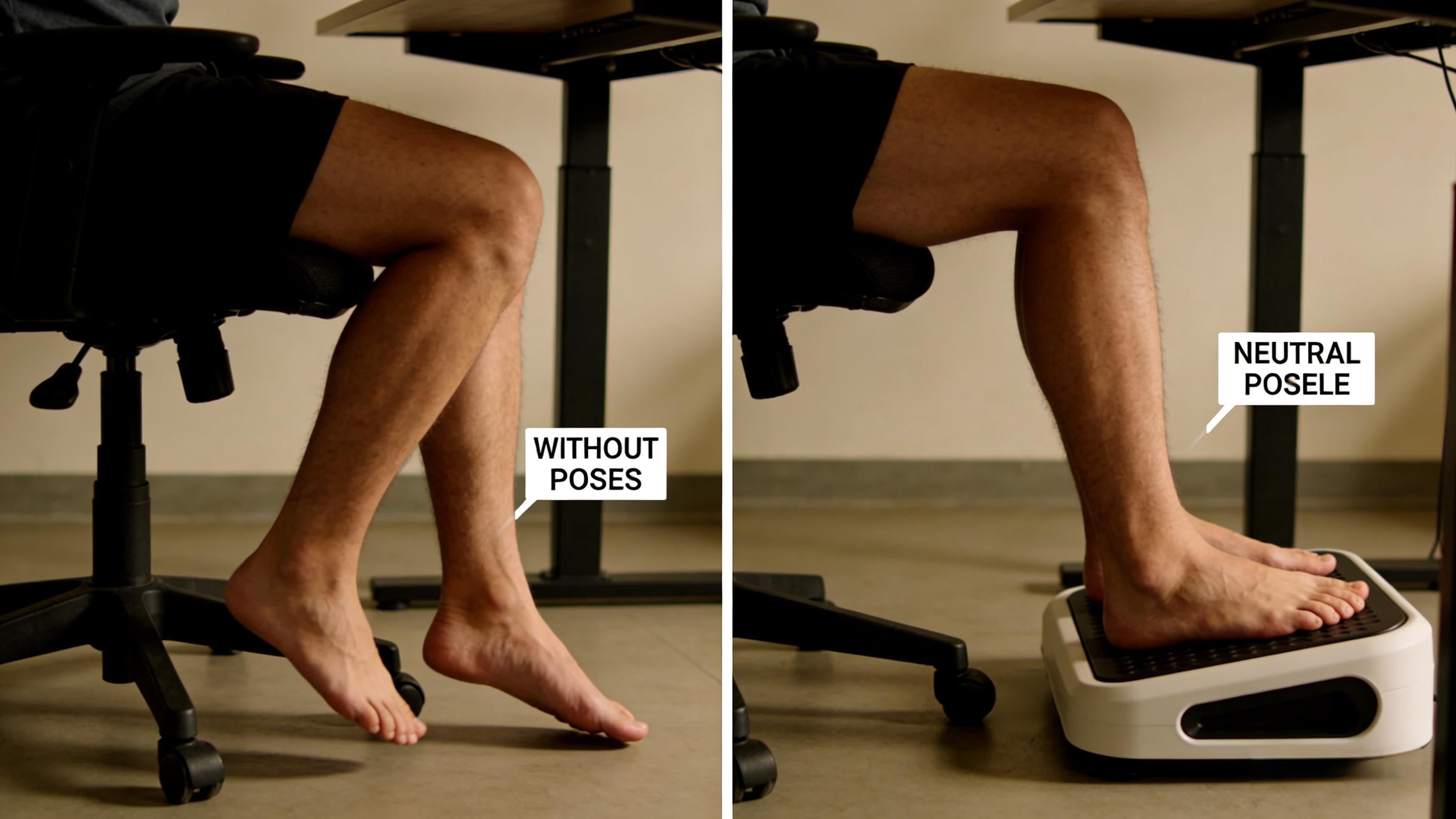
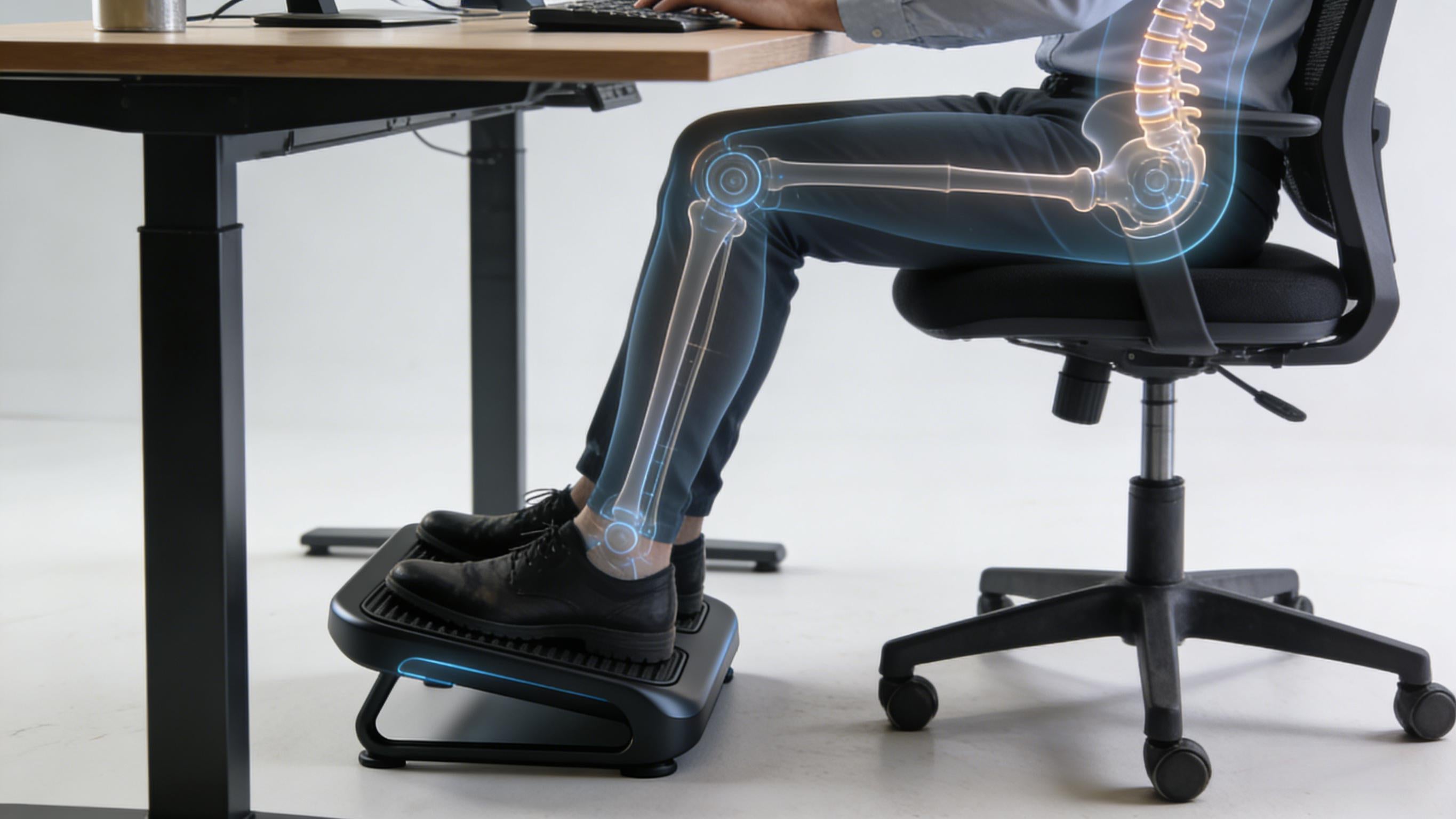
When feet are fully supported—either on the floor or on a foot rest—knee and hip joint angles are more likely to sit near a neutral range (roughly 90° at the knee in conventional seated posture). If feet dangle or are unsupported, several compensatory shifts occur:
- Posterior pelvic tilt: Shortened hamstrings and lack of foot grounding tend to pull the pelvis posteriorly, flattening lumbar lordosis and increasing disc pressure.
- Increased lumbar flexion: Without foot support, people may slump or adopt a forward-tilted posture to gain stability, increasing strain on lumbar discs and extensor muscles.
2. Muscle activation and distribution of load
Supported feet provide a stable base for the lower limbs, which distributes load across the hips and knees rather than concentrating it on soft tissues around the pelvis and lower back. Stabilized feet allow the core and postural muscles to work in balanced synergy, reducing localized fatigue.
3. Venous return and hydrostatic pressure
Sitting for long periods increases hydrostatic pressure in the legs—especially if feet are below heart level and inactive—leading to venous pooling and edema. A foot rest that allows the user to elevate or position their feet to a neutral angle and encourages micro-movements reduces venous pooling and supports venous return.
4. Neural comfort (numbness, paresthesia)
Unsupported feet can lead to compression of nerves at the thigh or popliteal region if a chair edge presses into soft tissues, or can cause ischemic sensations when blood flow stagnates. By supporting the feet and preventing pressure points, foot rests reduce these neural compression risks.
5. Functional outcomes
Functionally, better foot positioning leads to improved comfort, reduced perception of fatigue, increased ability to concentrate, and fewer breaks due to discomfort. These are measurable in workplace productivity contexts and are commonly reported in ergonomics assessments.
Top Benefits—Explained with Practical Tips
Below, each commonly stated benefit is analyzed with practical steps to achieve that benefit reliably.
Improves Circulation & Reduces Swelling
How it helps: Elevation to neutral ankle position and support reduces venous pressure, particularly for users whose feet don't reach the floor. Combined with small movements (ankle pumps, toe flexes), a foot rest reduces pooling and edema.
Practical tip: Use a foot rest with a slight rocking or textured surface to encourage ankle dorsiflexion and plantarflexion periodically—this simple motion is one of the most effective ways to increase venous return during long sitting periods.
Who benefits most: Shorter users, frequent flyers, postpartum workers, and anyone experiencing mild leg swelling after prolonged sitting.
Supports Posture & Spinal Alignment
How it helps: A foot rest enables a stable base to maintain neutral spine alignment. When hips are slightly higher than knees and feet are supported, lumbar lordosis is preserved more easily, reducing flexion at the lower back.
Practical tip: Combine a foot rest with a chair that provides adequate lumbar support. Adjust chair height so hips are slightly above knees, then fine-tune foot rest height so feet sit comfortably with the entire sole supported.
Reduces Leg Fatigue, Numbness & Tingling
How it helps: By preventing unsupported dangling, foot rests reduce strain on calf and thigh muscles and prevent pressure points that cause numbness. Properly adjusted, they distribute body weight more evenly and reduce localized pressure under the thighs and behind the knees.
Practical tip: If you experience numbness within 10 minutes of sitting, check for chair-edge pressure behind the knees and verify foot support. Short breaks and micro-movements combined with a foot rest usually resolve transient numbness.
Encourages Micro-movement & Active Sitting
How it helps: Active/rocking foot rests or textured platforms promote non-static posture by allowing slight foot movements. These micro-movements assist muscle pump action for venous return and reduce stiffness associated with static positions.
Practical tip: Instead of locking the feet in one position, intentionally move your feet every 10–20 minutes. If using a rigid foot rest, perform ankle pumps or heel-toe rocking exercises to achieve the same effect.
Watch: Footrest – Why You Need One
This video explains the benefits of using a foot rest, how it can support posture and reduce foot numbness when your feet don’t reach the floor.
Evidence, Guidelines & Expert Considerations
This section synthesizes principles commonly emphasized in ergonomics guidance and clinical practice without substituting for medical advice. Foot rests are a piece of ergonomic intervention evaluated in workplace health studies, and they are consistently recommended as a reasonable accommodation for workers with specific needs (short stature, pregnancy-related swelling, or circulatory discomfort).
What ergonomics guidelines typically say
- Provide a stable foot surface for people whose feet do not reach the floor when seated to maintain comfortable hip and knee angles.
- Encourage regular movement—foot rests are adjuncts to movement, not replacements.
- Adjustability is preferred in shared workspaces to accommodate multiple users.
Expert considerations
Physical therapists and occupational health practitioners emphasize individualized fitting: the ideal foot rest height and tilt can vary among users and tasks. Clinical concerns (e.g., peripheral vascular disease, lymphedema, recent surgery) may change recommendations; people with specific health conditions should seek personalized medical guidance.
Who Needs a Foot Rest? Scenario-by-Scenario Advice
Not everyone needs a foot rest all the time. Use the guidance below to identify whether one is likely to help you and how to customize it for your scenario.
Office Workers & Remote Employees
If your chair height is high or your desk is fixed and your feet don't reach the floor comfortably, a foot rest is often the simplest and most cost-effective intervention. For shared workspaces, an adjustable model works best.
Shorter Individuals
Shorter users frequently cannot place their feet flat on the floor when chairs are set at the standard desk height. A taller foot rest or angled platform helps achieve a neutral lower limb alignment and prevents slouching.
Sit-Stand Desk Users
Foot rests are useful during seated portions of sit-stand workflows. When standing, the foot rest should be removed or set aside. Some sit-stand users prefer a portable or foldable foot rest for quick transitions.
Pregnant Individuals
Pregnancy can increase lower limb swelling and discomfort. A foot rest that permits elevation and encourages micro-movement can reduce pooling and improve comfort—always follow medical advice for swelling management during pregnancy.
Frequent Travelers and Airplane Use
Inflatable or compact foot rests designed for travel help reduce lower limb discomfort on long flights. They encourage subtle elevation and movement, reducing the perception of stiffness.
Gamers & Creative Professionals
Gaming or intensive creative work often involves prolonged sitting. An ergonomic foot rest combined with regular posture checks and breaks enhances endurance and comfort.
Drivers & Vehicle Occupants
While foot rests are less applicable in cars, adjustments to seat position and lumbar support can mimic some benefits. For long-haul drivers who frequently stop and rest, portable elevation or stretching routines are recommended.
People with Specific Health Concerns
For users with lymphedema, peripheral neuropathy, or prior DVT, a foot rest should be considered in consultation with medical professionals, who may recommend compression garments, elevation schedules, or other interventions beyond ergonomics.
How to Choose the Right Foot Rest — Buyer’s Guide & Decision Matrix
Choosing the right foot rest requires bridging user needs with product specs. The matrix below helps map features to priorities.
Key selection criteria
- Adjustability: Height and tilt adjustments increase usefulness across users.
- Surface area & shape: Enough room to place both feet comfortably.
- Stability & non-slip base: Essential for safety and comfort.
- Material & comfort: Memory foam for cushioning vs hard plastic for stability—choose based on preference and duration of use.
- Active vs passive: Rocking/rolling models promote movement; rigid models provide stable support.
- Portability: For shared desks or travel, consider weight and foldability.
- Price & warranty: Balance budget with durability and a vendor warranty.
Decision matrix (use this to pick)
| Priority | Recommended Feature | Why it matters | Who should pick this |
|---|---|---|---|
| Maximum adjustability | Adjustable height + tilt | Fits multiple users and workflows; fine-tunes ankle/knee angles | Shared offices, hot desks |
| Active movement | Rocking or textured rocking platform | Encourages micro-movement for circulation | People prone to swelling or stiffness |
| Comfort | Memory foam or cushioned top | Reduces plantar pressure—good for long sessions | Gamers, long-duration desk users |
| Travel | Inflatable / lightweight foldable | Easy to carry, quick set-up on flights or temporary desks | Frequent travelers |
| Budget | Simple molded foam or plastic platform | Low cost and reliable for basic support | Cost-conscious buyers |
Buying checklist (quick)
- Is the height adjustable for your chair and desk combination?
- Does the platform area fit both feet comfortably?
- Is the surface non-slip or textured?
- Does the model support subtle movement if you want active sitting?
- Is it portable if you plan to move it between settings?
Tip: If unsure, pick an adjustable model—even a modest price premium usually yields better long-term fit and utility across users.
Watch: When Should You Use an Ergonomic Footrest & How to Choose the Right Model
A practical video showing when an ergonomic footrest is useful and key points for choosing the right model depending on your setup.
How to Set Up & Adjust a Foot Rest (Step-by-step)
The following stepwise approach helps you quickly find a comfortable and effective setup. Follow each step, check comfort, and iterate.
Step 1 — Prepare your workstation
Start from a neutral baseline: your chair height should allow your feet to rest flat on the floor if no foot rest is used. If your desk is fixed and you cannot change chair height (or doing so causes other ergonomic issues), proceed with a foot rest to achieve a neutral limb position.
Step 2 — Sit comfortably and align your hips and knees
Sit so your hips are level or slightly higher than knees. Slight elevation of the hips relative to knees preserves lumbar curvature and reduces posterior pelvic tilt.
Step 3 — Place the foot rest under your feet
Position the foot rest so both feet can rest fully on its surface without the heels hanging off or toes cramping. If needed, move the foot rest forward or back to ensure comfortable reach.
Step 4 — Adjust height
Raise or lower the foot rest until knees are near 90 degrees. Shorter users may need a greater lift; taller users might only need a slight elevation to eliminate dangling.
Step 5 — Adjust tilt for ankle position
If the foot rest has a tilt adjustment, set a small incline that keeps the ankle near neutral. Too much plantarflexion (toes pointing downward) causes calf strain; too much dorsiflexion (toes pulled up) can cause discomfort behind the knee—aim for comfort and a natural alignment.
Step 6 — Check for pressure points
Ensure the chair edge is not compressing behind the knees and that the foot rest is not creating hotspots under the feet. If pressure is noted, try a foot rest with cushioning or use a shallow wedge to redistribute pressure.
Step 7 — Add movement routines
Set a simple micro-break schedule: every 30–60 minutes stand briefly or perform a 60-second ankle pump sequence (dorsiflexion/plantarflexion) to stimulate blood flow.
- Feet fully supported
- Knees ~90° (or hips slightly higher)
- Neutral ankle position
- No pressure behind knees
- Micro-movements scheduled
Common Mistakes & Quick Fixes
- MISTAKE: Using a foot rest that is too low. FIX: Increase height until feet are fully supported and knees are near 90°.
- MISTAKE: Locking feet statically. FIX: Use a rocking or textured surface or perform ankle pumps periodically.
- MISTAKE: Choosing only cushioning without stability. FIX: Balance cushioning with a stable base; memory foam over an unstable base may be uncomfortable.
- MISTAKE: Not addressing chair fit first. FIX: Adjust chair lumbar support and arm height before finalizing foot rest position.
- MISTAKE: Over-relying on the foot rest as a solution for systemic circulatory issues. FIX: Seek medical advice for chronic swelling or pain—use the foot rest as an adjunct intervention.
Product Comparison Table — Quick Choices
The table below summarizes typical category picks. These are representative feature sets (not brand endorsements).
| Category | Typical Features | Best for | Pros | Cons |
|---|---|---|---|---|
| Basic molded platform | Fixed height, plastic, textured surface | Budget users | Cheap, durable | No adjustability |
| Adjustable height & tilt | Multiple height settings, tilt control | Offices with multiple users | Versatile, fits many users | Higher cost |
| Active/rocking | Rocking/rolling top, textured | Circulation & micro-movement | Encourages movement, reduces pooling | Some users find it distracting |
| Memory foam cushion | Padded top on low profile base | Long-duration comfort seekers | Padded comfort, reduces plantar pressure | Less stable for heavy users |
| Inflatable travel foot rest | Compact, inflatable, lightweight | Travel & flights | Portable | Less durable, not ideal for daily office use |
Note: If you plan to recommend specific models on your site, include Product schema and user reviews or ratings to increase conversion potential and search snippet opportunities.
Downloadable Setup Checklist (copy & paste / print)
You can copy this checklist into a document and use it while setting up a workstation or when testing multiple foot rest models.
Foot Rest Setup & Use Checklist

[ ] Chair height set so hips are level or slightly higher than knees
[ ] Feet rest fully on foot rest surface (heels included)
[ ] Knees approximately 90° (or slightly above for neutral spine)
[ ] Ankle position is neutral (avoid extreme toe-down or toe-up)
[ ] No pressure behind knees (chair edge clear of popliteal region)
[ ] Platform large enough for both feet to rest naturally
[ ] Surface non-slip or textured to prevent sliding
[ ] If adjustable: tilt set to slight incline (5–15°) for neutral ankle
[ ] Schedule micro-movement: stand or ankle pumps every 30–60 minutes
[ ] For shared desks: store height/tilt preferences for main users
[ ] If swelling or pain persists: consult healthcare professional
FAQ — Common Questions Answered
Do foot rests really improve circulation?
Yes—when used properly, foot rests encourage neutral limb angles and can reduce venous pooling. Pair foot support with brief regular movement (ankle pumps) to maximize benefits.
How high should a foot rest be?
Height should allow the knees to be approximately at 90° with hips slightly higher for many users. Adjustability is key—height that fits one person may not fit another.
Are rocking foot rests better?
They can be, if your goal is to encourage micro-movement. Rocking or textured platforms stimulate calf pump activity and reduce stiffness. Some users find rocking distracting—choose based on personal preference.
Can foot rests help with lower back pain?
Indirectly. Foot rests help maintain spinal alignment by stabilizing the base; this can reduce undue lumbar flexion. However, chronic or severe back pain should be evaluated by a healthcare professional.
Who should NOT use a foot rest?
People with specific medical conditions (e.g., severe peripheral vascular disease, recent lower limb surgery, active DVT) should consult their doctor. For most healthy users, foot rests are safe and helpful.
How often should I adjust my setup?
Check your setup after any change in desk, chair, or task. Periodically re-evaluate every 1–3 months or whenever discomfort appears.
Conclusion
A foot rest is a low-cost, high-impact ergonomic intervention for many people—particularly those who cannot comfortably place their feet on the floor or who sit for extended periods. The best outcomes come from combining the right product choice, careful setup, and regular movement. Use the decision matrix and checklist in this guide to choose and configure your foot rest, and pair it with broader workstation optimizations (lumbar support, chair fit, monitor height, and break scheduling).
References & Further Reading
- Effects of Compression Stockings on Lower-Limb Venous and Arterial Responses to Prolonged Sitting – PubMed — Research examining blood pooling, venous return, and lower-limb circulation changes associated with prolonged sitting.
- DVT Prevention Exercises – American Blood Clot Association — Educational resource explaining how lower-leg movement and simple seated exercises help promote circulation and reduce blood pooling during prolonged sitting.
- OSHA Ergonomic Solutions – Lower Extremities — Official OSHA ergonomics guidance covering sitting posture, lower-limb circulation, footrests, and methods to reduce lower-body fatigue in seated work environments.
- OSHA Ergonomics Program Management Guidelines — Official U.S. Department of Labor ergonomics guidance covering seated posture, workstation adjustment, lower-body support, and ergonomic practices for reducing fatigue and musculoskeletal strain.
- How Office Workers Can Improve Blood Circulation in the Legs – Cardinus — Workplace ergonomics guidance explaining how footrests, posture adjustments, and seated movement can help improve lower-leg circulation during prolonged desk work.
- Tips to Protect Your Leg Veins While Working – Banner Health — Medical guidance explaining how prolonged sitting affects leg circulation and how movement, posture, and workstation habits can help reduce lower-leg discomfort and fatigue.
- The Importance of Footrests at Work – Ergonoma — Workplace ergonomics article discussing how footrests support posture, reduce pressure on the lower limbs, and improve seated comfort during desk work.