



The Ultimate Guide to Seat Cushions (Chair Pads) — Comfort, Pain Relief & How to Choose
Everything you need to know about seat cushions: the science, materials, real-world test evidence, how to pick the right cushion for your chair and body, installation & care, data-driven model picks for office/driving/wheelchair/pregnancy, and an extensive FAQ. Evidence-backed and practical — designed to outrank shallow product pages and provide real value to readers.
Why Seat Cushions Matter — The Science & Evidence
Seat cushions are more than a comfort accessory: they can change pressure distribution, encourage healthier posture, reduce pain from prolonged sitting, and improve circulation over long sessions. The best recommendations come from combining biomechanics, clinical study findings and real-world ergonomics guidance.
Key evidence highlights (summarized):
- Gel cushions have been shown in randomized or controlled studies to reduce low back pain in some occupational groups (for example, professional drivers) compared with some foam cushions, likely because gel redistributes pressure and reduces peak interface pressure.
- Dynamic seat cushions — designs that encourage micro-movements and postural shifts — have produced measurable reductions in neck and lower-back pain in office populations in recent trials. Frequent postural shifts during sitting are a key protective mechanism.
- Pressure-redistribution research (pressure mapping) demonstrates that different cushion materials and shapes produce distinct interface pressure patterns; selecting the correct cushion depends on your body shape, condition (e.g., coccydynia, sciatica) and sitting duration.
- Ergonomics authorities emphasize that a supportive chair and proper positioning are essential; cushions are adjuncts — they assist but don't replace a chair with proper lumbar support and adjustability. Occupational guidance articulates adjustability, lumbar conformity and seat pan considerations as core features.
Bottom line: seat cushions can be effective, but not all cushions are equally helpful for every person or problem. Match cushion type to use case and body mechanics, and treat cushions as part of a broader ergonomic solution (chair + desk setup + movement breaks + exercise).
Types of Seat Cushions (Memory Foam, Gel, Hybrid, Air, Dynamic)
Understanding material and design categories is the first step toward choosing the right cushion. Below you'll find the major types, their mechanical characteristics, pros & cons, and typical use cases.
Memory Foam (Viscoelastic)
What it is: Viscoelastic polyurethane foam that compresses under heat/pressure, molding to the body. Memory foam cushions vary in density and thickness.
Advantages: Excellent for contouring and pressure distribution for many users; good for longer sitting when combined with breathable covers or cutouts for tailbone relief.
Limitations: Can retain heat (unless gel-infused or ventilated); lower-density foams may collapse over time; not all memory foam products provide targeted coccyx relief.
Gel Cushions
What it is: Gel pads or inserts (often polyurethane gel or silicone-like substrates) embedded in foam or in a gel cushion body.
Advantages: Excellent at redistributing peak pressure, cooling properties in some designs, and beneficial outcomes in some clinical studies for long-seated drivers. Evidence suggests gel cushions can reduce low back symptoms in specific populations.
Limitations: Can be heavier; cheaper gels may degrade; not all gel cushions are well ventilated.
Hybrid (Memory Foam + Gel / Layered)
Combines foam contouring with a gel layer for cooling and pressure smoothing. Hybrids aim to balance contouring with temperature control and durability.
Air / Inflatable Cushions
Inflatable cushions let users adjust firmness. They can be helpful for personalizing pressure relief and are sometimes used in medical contexts for pressure sore prevention.
Dynamic / Active Cushions
What it is: Cushions that intentionally encourage micro-movements — e.g., alternating air chambers, wobble surfaces, or designs that biomechanically prompt postural shifts.
Why it matters: Clinical trials indicate these cushions increase postural shifts and reduce neck/back pain incidence or shorten recovery time for office workers, probably because they avoid long static postures.
Specialized Medical Cushions
Used for specific clinical needs (pressure ulcer prevention, post-surgical healing). Typically evaluated using pressure mapping and clinical endpoints; selection should be clinician-guided for high-risk patients.
| Type | Main Material / Construction | Best For | Key Performance Traits | Recommended Thickness | Breathability | Durability | Notes |
|---|---|---|---|---|---|---|---|
| Memory Foam | High-density viscoelastic foam | Office work, contouring, general pressure distribution | High contouring; medium peak pressure reduction; good support for many body shapes | 2–4 in (5–10 cm) | Moderate (better with ventilated channels / breathable cover) | High (if density ≥ 50 kg/m³ or equivalent) | May retain heat; choose gel-infused or ventilated versions for cooling |
| Gel / Gel-Infused Hybrid | Gel pads or gel top layer combined with foam | Long driving sessions; hot environments; users needing peak pressure smoothing | Lower peak interface pressures; can provide cooling and vibration damping | 1–3 in (2.5–8 cm) gel layer over foam | Usually good (gel conducts heat away) | Good (depends on gel material quality) | Clinical trials suggest benefit in driver populations for low back symptoms |
| Air / Inflatable | Adjustable air cells / chambers | Active sitting, personalized pressure management, some medical use | Highly adjustable firmness; can equalize pressure if set correctly | Varies (thin to medium) — depends on chamber count | Excellent (air flow through cells) | Moderate (vulnerable to puncture unless reinforced) | Requires maintenance and correct inflation; medical models designed for long use |
| Dynamic / Active | Alternating chambers, wobble / unstable top surfaces | Users who need more micro-movement to prevent stiffness | Promotes postural shifts; reduces static loading duration | 1–3 in (2.5–8 cm) effective top layer | Varies | Good (mechanical parts can wear on cheaper models) | Best used in combination with a supportive chair and not for heavy stability needs |
| Hybrid (foam + gel/air) | Layered foam with gel insert or air channels | All-day comfort; users wanting balance of contouring + cooling | Balanced pressure redistribution, better thermal control than pure foam | 2–4 in (5–10 cm) | Good to excellent | High (depends on construction quality) | Often best generalist option if specs are transparent |
How Seat Cushions Help — Pressure, Posture & Circulation
There are three primary mechanisms through which cushions assist occupants during prolonged sitting:
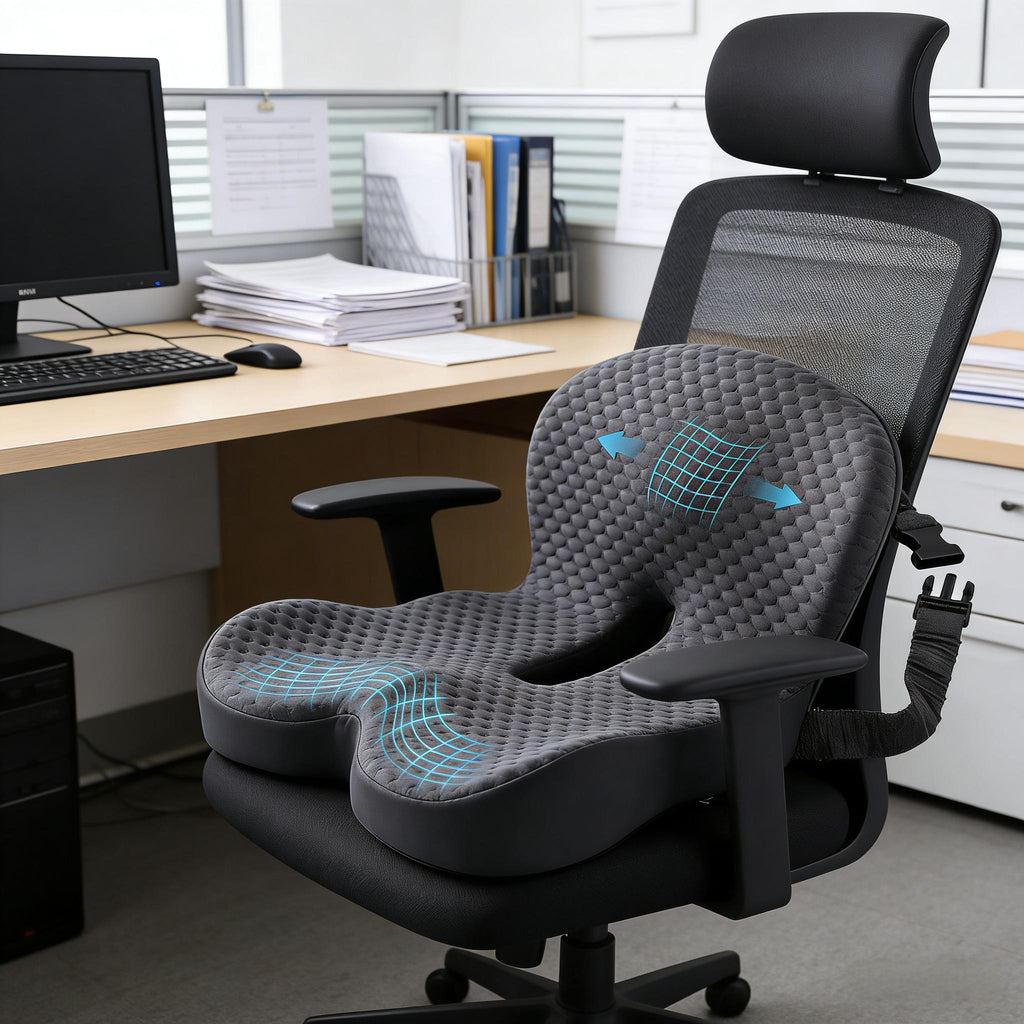
- Pressure redistribution: A well-designed cushion lowers peak interface pressure beneath bony prominences (ischial tuberosities, coccyx) and spreads load across a larger surface, reducing localized stress that can cause pain. Pressure-mapping experiments demonstrate measurable differences across cushion types.
- Postural support: Cushions with a contoured profile or a tailored wedge can influence pelvic tilt and lumbar curvature — complementing chair lumbar support and promoting neutral spine alignment when used correctly. OSHA and other ergonomics resources emphasize that seat geometry and lumbar support work together to reduce spinal strain.
- Movement facilitation: Dynamic cushions promote micro-movements and postural shifts, which reduce the duration of static loading on the spine and adjacent soft tissues. Research shows dynamic cushions can increase postural shifts and correlate with less spinal discomfort.
Important: cushions do not replace a poorly designed workstation or compensate for no movement. They are most effective when combined with regular breaks, correct chair settings, and targeted exercises (see "When to See a Doctor" and the exercise suggestions later).
Material & Design Metrics You Should Know
When evaluating cushions, look beyond marketing buzzwords. The following technical metrics influence real-world performance:
Foam Density & ILD (Indentation Load Deflection)
Foam density (kg/m³ or lb/ft³) correlates with durability and support; higher density generally supports for longer but may feel firmer initially. ILD measures how resistant foam is to indentation — lower ILD is softer. For memory foam cushions, aim for density and ILD specifications (if provided) that match intended use: longer sitting often benefits from medium-high density with moderate ILD for both contouring and durability.
Peak Interface Pressure & Pressure Mapping
Pressure mapping (measured with a pressure mat under the seat) shows where pressure concentrates. Designers use this to optimize zones (e.g., cutouts for coccyx, firmer lateral wings to support thighs). Studies show that gel and hybrid designs often reduce peak pressures compared with thin foam pads.
Thermal Conductivity & Ventilation
Heat build-up is a common complaint. Ventilated foam channels, breathable covers (mesh, perforated neoprene), and gel layers that conduct heat away are practical features to prefer for long-duration sitting.
Durability & Recovery
Rebound (how quickly the material returns to shape), compression set (permanent deformation after use) and long-term load testing are helpful indicators. Cheaper low-density foams can flatten quickly; high-density memory foam or reinforced hybrids retain support longer.
Cutouts & Ergonomic Shape
Coccyx or U-shaped cutouts reduce direct pressure on the tailbone; wedge shapes alter pelvic tilt. These are important design choices depending on the intended benefit (tailbone pain relief vs. posture support).
Tip: if product pages do not disclose density, ILD, or test results — treat the product as lower transparency. Favor models that publish objective metrics or third-party test results.
How to Choose a Cushion by Use Case (Office, Driving, Wheelchair, Pregnancy, Post-op)
Context is everything. The best cushion for a long-haul truck driver differs from the one for a patient recovering from coccygectomy. Below is a practical decision matrix and evidence-informed recommendations.
Decision Matrix — Quick Guide
| Use case | Primary need | Recommended type | Notes |
|---|---|---|---|
| Office (≥6 hours/day) | Postural support + pressure redistribution | Medium-density memory foam + gel layer OR dynamic cushion | Pair with adjustable lumbar chair; take movement breaks. |
| Driving / Long drives | Reduce peak pressure & vibration | Gel cushion or hybrid with anti-vibration layer | Gel has clinical evidence in driver populations. |
| Wheelchair users | Pressure sore prevention, long-duration load | Medical-grade air or high-spec pressure-redistributing foam | Clinician evaluation recommended for high-risk patients. |
| Pregnancy | Pelvic comfort & tailbone relief | Contoured memory foam with coccyx cutout | Lightweight, breathable, and stable on seat pan. |
| Post-op / tailbone pain | Offloading bony prominence | U-shaped cutout or ring cushion (medical-grade) | Follow clinician instructions; avoid excessive compression. |
Office Workers (long sitting)
For office workers who sit many hours daily, choose a cushion that balances contouring and breathability. Dynamic cushions that promote postural shifts can reduce recurrence of neck/low-back pain in office settings. If you prefer a static cushion, look for medium-to-high density memory foam with a gel layer or ventilated channels and consider a coccyx cutout if tailbone discomfort is present.
Driving & Professional Drivers
Long-distance drivers can get substantial benefits from gel or hybrid cushions that reduce peak pressure and improve comfort during continuous vibration and prolonged sitting; clinical evidence has shown gel cushions to be helpful in occupational drivers.
Wheelchair Users & Medical Needs
Wheelchair cushions are a clinical domain. Pressure-relief cushions (alternating air, high-spec foam, or specialized gels) are used to prevent pressure ulcers. Selection should be individualized with clinician input and based on pressure mapping and skin integrity assessments.
Pregnancy & Postpartum
Pregnant individuals often benefit from slightly thicker cushions with stable bases and breathable covers. Avoid excessively soft cushions that cause pelvic instability. Postpartum or post-surgical patients should follow specific medical guidance.
Remember: weight distribution, pelvis width, existing conditions (sciatica, coccyx pain), and seat geometry are all variables — use the matrix, but prefer testing a model when possible.
Fitting, Installation & Maintenance — Step-by-step
How to Measure & Fit a Cushion (Step-by-step)
- Measure seat pan width & depth: Measure the widest points of the chair seat (inside armrests if present) and seat depth (from backrest to front edge). Choose a cushion slightly narrower than the seat width so it sits securely.
- Check seat tilt & pan depth: If your chair has a deep pan, choose a cushion that doesn't push you forward; wedge or tapered designs can help maintain thigh support and avoid sliding.
- Assess how the cushion seats against the backrest: Ensure the cushion doesn't lift your pelvis too far forward; your backrest should continue to support the lumbar curve.
- Try while wearing typical clothing: Seat feel changes with clothes (e.g., jeans vs. soft trousers). Test in realistic conditions for 15–30 minutes if you can.
- Confirm slip resistance: If cushion slips on upholstery, add a non-slip pad or choose a cushion with a non-slip base. Avoid using tape directly on fabric.
Cleaning & Care
Follow manufacturer instructions. General tips:
- Use removable covers that are machine-washable.
- Spot-clean foam cores with mild soap and water; avoid saturating foam.
- Air out gel cushions periodically to prevent odors.
- For inflatable cushions, check valves and maintain recommended pressure.
When to Replace a Cushion
Signs you need a new cushion:
- Permanent compression or sagging (material does not rebound).
- New or worsening discomfort after the "break-in" period.
- Punctures, delamination of gel modules, or flattened foam layers.
Replace cushions proactively for safety-critical uses (wheelchair users, post-op patients) — consult clinicians for replacement schedules in medical contexts.
Real Tests & Comparisons — What the Evidence Shows
High-quality product pages often make claims, but objective testing reveals nuanced performance differences. Below are key findings from peer-reviewed and experimental studies that help inform buyer decisions.
Gel vs. Foam: Evidence in Occupational Drivers
Randomized/controlled trials focusing on occupational drivers found that gel cushions can lead to reductions in low-back pain compared with some conventional foam cushions — likely due to better peak pressure redistribution and vibration damping. These studies support selecting gel or gel-hybrid cushions for long, continuous driving tasks.
Dynamic Cushions & Postural Shifts
Trials of dynamic seat cushions have shown increases in postural shift frequency and reductions in neck and low-back pain in office workers. The mechanism appears related to reducing static loading periods and increasing trunk muscular engagement. While promising, some trials call for larger sample sizes; nonetheless, dynamic designs are a practical option for users prone to stiffness from static sitting.
Pressure Mapping Studies
Laboratory pressure-mapping research with healthy volunteers demonstrates measurable differences in interface pressure across cushion types and by age group. Pressure mapping is a useful objective tool in clinical and product-testing environments; cushions designed with zonal pressure redistribution or cutouts show clear reductions in peak pressures near the coccyx and ischial tuberosities.
Interpretation tip: not every reduction in peak pressure equals clinical pain relief for every person. Combine objective mapping with user-reported comfort and functional outcomes when selecting a cushion.
Top Picks by Use Case — Data-driven Recommendations
Below are illustrative recommendations oriented around use-case categories. These picks emphasize models that publish objective metrics, support transparency (density, tests), or are frequently used in clinical contexts. (This section is intentionally product-agnostic on branding — evaluate models in your price range that fit the specs below.)
Office: Balanced Comfort & Movement
- Type to prefer: Hybrid memory foam + gel layer OR dynamic cushion that encourages micro-movements.
- Why: Combines pressure redistribution with breathability and postural support; dynamic designs reduce recurrence.
- Key features to look for: Medium-high density foam, gel infusion or top layer, breathable cover, non-slip base, documented ILD/density if available.
Driving: Peak Pressure & Vibration Reduction
- Type to prefer: Gel cushion or hybrid with anti-vibration layer.
- Why: Clinical evidence shows gel cushions can reduce low back symptoms in drivers.
- Key features to look for: Gel layer, anti-slip bottom, contoured seating surface for pelvis stabilization.
Wheelchair & Medical Use
- Type to prefer: Clinically tested pressure redistribution cushions (air-alternating or high-spec viscoelastic foam)
- Why: Prevention of pressure ulcers and maintenance of skin integrity requires medical-grade solutions and clinician oversight.
When comparing models, prioritize transparency (published specs), test data, warranty, return policy (try-at-home) and third-party clinical endorsements.
Common Mistakes & Myths
“The thicker the cushion, the better”
Not always. Excessive thickness can push your pelvis into an unstable position, causing poor lumbar contact with the chair back and increased strain. The best cushion provides a balance of thickness and firmness suitable to seat depth and your body.
“Any cushion will fix my back pain”
Back pain is multifactorial. Cushions can help with specific mechanical issues (tailbone pressure, peak pressure), but they do not replace diagnosis, exercise, or workstation correction. If pain is persistent or severe, see a clinician.
“Inflatable is always best because it's adjustable”
Inflatable cushions are useful for adjustability, but they are not automatically superior. Air cushions can puncture and require maintenance; for long-duration seating, medical-grade air cushions are designed with redundancy and clinical protocols.
“You should always get the most expensive cushion”
Price correlates with materials and testing but is not the only determinant of suitability. Prioritize fit, testability (return policy) and objective performance data over price alone.
When to See a Doctor
Consult a healthcare professional when any of the following occur:
- Severe, new, or worsening back pain that limits daily activities or includes neurological signs (numbness, weakness, bowel/bladder changes).
- Skin changes or non-healing wounds under prolonged pressure (important for wheelchair users).
- Pain that persists despite appropriate cushion changes, chair adjustments, and conservative measures like exercise. Evidence-based self-care is useful, but persistent symptoms require professional assessment.
Useful clinical guidance: combine cushion selection with a clinician-directed plan that includes strengthening, posture retraining, and validated rehabilitation protocols when needed.
Complete Your Ergonomic Desk Setup
A seat cushion significantly improves lower-body comfort, but long-term sitting comfort depends on how your entire workstation supports posture and load distribution. The following guides help address the most common pressure points during prolonged desk work.
Foot Rests for Better Leg Posture
Reduce lower-leg fatigue and improve circulation by maintaining proper foot and knee alignment while seated.
Laptop Stands for Proper Screen Height
Elevating your laptop helps align screen height with eye level, reducing neck strain and supporting healthier sitting posture.
Monitor Stands & Screen Height Alignment
Correct screen positioning minimizes neck and upper-back strain, complementing improved seating support.
FAQ
Which cushion is best for sciatica?
There is no single universal “best” cushion for sciatica — match the cushion to your pain location and mechanism. For nerve-related pain radiating down the leg, a cushion that reduces pelvic compression and promotes neutral pelvic tilt (contoured foam or hybrid) is often helpful. Always pair cushion use with posture, movement breaks, and clinical advice.
Are gel cushions better than memory foam?
Both have strengths. Gel is often better at lowering peak pressure and can be cooler; memory foam contours and can distribute load effectively. Hybrids combine both benefits. Clinical trials in some groups (e.g., drivers) showed gel cushions reduced low-back symptoms compared with some foam cushions.
How long should I try a cushion before deciding?
Try it for at least two weeks with typical sitting patterns; allow several days for "break-in" as foam contours to you. If the vendor offers a trial/return policy (7–30 days), use it to test real-world comfort across a workweek.
Can a cushion fix my posture?
A cushion can influence pelvic tilt and lower-spine alignment, but it’s not a stand-alone posture cure. Combine a good chair, monitor/desk setup, regular movement, and core-strengthening routines for meaningful posture improvement. OSHA-style workstation adjustments remain critical.
Do cushions reduce the risk of pressure ulcers?
Specialized medical cushions (air-alternating or high-spec foam) are used preventatively in at-risk populations. For general users, choosing a cushion that reduces peak pressure is the right principle; clinical-grade cushions and clinician oversight are necessary for high-risk individuals.
References & Further Reading
Below are selected peer-reviewed studies, clinical trials, and scientific articles that provide objective evidence on seat cushion pressure distribution, dynamic cushion effects, and clinical outcomes related to prolonged sitting and ergonomic seating.
- Effect of gel seat cushion on chronic low back pain in occupational drivers — Randomized clinical trial evaluating whether gel seat cushions may reduce chronic low back pain and improve sitting comfort among occupational drivers.
- The effectiveness of a dynamic seat cushion in preventing neck and low-back pain among high-risk office workers — A 6-month cluster randomized trial suggesting that dynamic seat cushions encouraging postural shifts may help reduce neck and low-back pain incidence.
- Effects of different seat cushions on interface pressure distribution — Pilot study comparing pressure redistribution across cushion types, showing measurable differences in peak and contact pressures.
- Seat cushion optimization: a comparison of interface pressure characteristics for spinal cord injured and elderly patients — Study highlighting how cushion design affects interface pressure redistribution in vulnerable seating populations.
- Pressure ulcer prevention with pressure-reducing seat cushions — Review of clinical evidence suggesting that pressure-reducing cushions may help lower pressure ulcer risk in at-risk populations.
- Postural shifts and body perceived discomfort during 1-hour sitting on an air-filled seat cushion — Experimental study linking increased postural shifts with reduced sitting discomfort.
- Development of a low-cost pressure mapping device to evaluate force distribution for seat cushion modification — Scientific Reports article describing pressure-mapping methods used to assess force distribution and optimize seat cushion performance.
- [Use original article title here] — Open-access study comparing pressure redistribution across multiple seat cushion materials and designs.
These references provide objective, scientific data on cushion performance, ergonomic effects of seat surfaces, and clinical outcomes related to prolonged sitting. Many are randomized controlled trials or comparative studies, which are considered high levels of evidence in evidence-based practice.